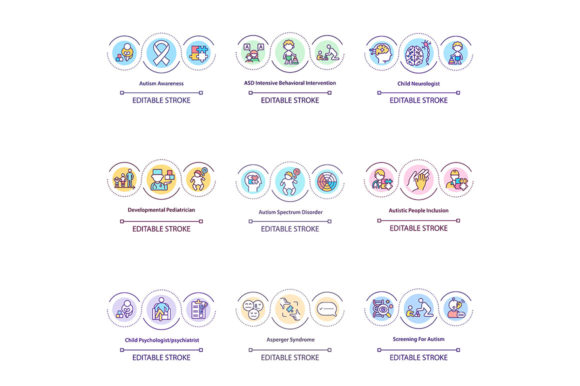
Autism Spectrum Disorder Concept Icons for Design
Visual communication in healthcare and education requires a delicate balance of accuracy, empathy, and clarity. When designing materials related to neurodiversity, generic clip art often fails to capture the nuance required for professional presentations. This is where a dedicated Autism Spectrum Disorder Concept Icons set becomes an essential asset. These specialized vector illustrations go beyond simple representation; they serve as functional tools for therapists, educators, and marketers who need to convey complex developmental concepts without relying on dense text. Whether you are creating a brochure for a new clinic or developing a mobile app for verbal behavior intervention, having access to high-quality, editable outline drawings ensures your message resonates with both professionals and families.
Precision in Developmental Disability Illustrations
The primary strength of this icon set lies in its specific focus on developmental disabilities and therapeutic interventions. Unlike broad medical icon packs, these illustrations are tailored to the unique vocabulary of autism support. You will find visuals representing verbal behavior intervention, sensory processing, social skills training, and cognitive development. This specificity matters because it signals to your audience that you understand the subject matter. For a speech-language pathologist creating patient handouts, an icon depicting "manding" or "tact" is infinitely more useful than a generic speech bubble. The thin line color style offers a modern, non-clinical aesthetic that feels approachable rather than sterile, helping to reduce anxiety in sensitive communications.
Furthermore, the isolated nature of these vector drawings allows for seamless integration into existing design systems. Because they are created with consistent stroke weights and visual metaphors, they maintain cohesion across different media. A presentation slide featuring these icons will visually match the clinic’s website or printed intake forms, reinforcing brand identity. This consistency is crucial for building trust with parents and caregivers who are often navigating overwhelming amounts of information. When your visual language is stable and professional, it subconsciously communicates reliability and organizational competence.
Technical Flexibility for Modern Workflows
Creative professionals know that file format dictates utility. This collection supports diverse workflows by providing JPEG, AI, PNG, EPS, and SVG formats. Each serves a distinct purpose in the production pipeline:
- SVG and EPS: Essential for scalable vector graphics that remain crisp at any size, from business cards to billboards. These formats preserve the editable stroke data.
- AI (Adobe Illustrator): Allows designers to modify colors, adjust line thickness, or combine elements to create custom composite illustrations.
- PNG: Perfect for web use, PowerPoint presentations, and digital documents where transparency is needed without vector editing capabilities.
- JPEG: Useful for quick previews or platforms that do not support transparency.
The inclusion of editable strokes is perhaps the most significant technical advantage. Brand guidelines often require specific color palettes or line weights. With raster-only icons, you are stuck with what you get. With these editable vectors, you can adjust the stroke width to match your typography or recolor the entire set to align with your organization’s branding in minutes. This flexibility transforms a static asset pack into a dynamic design system component, saving hours of redrawing time and ensuring compliance with accessibility standards regarding color contrast.
Practical Applications Across Industries
The versatility of Autism Spectrum Disorder Concept Icons extends far beyond clinical settings. Educators utilize them to create visual schedules and classroom rules that are accessible to neurodivergent students. Visual supports are evidence-based practices in special education, and having a library of consistent, high-quality icons makes producing these materials significantly faster. Instead of searching disparate sources for mismatched images, teachers can assemble cohesive learning aids that help students navigate transitions and expectations independently.
In the digital product space, app developers and UX designers leverage these assets for mobile app screen pages and user interfaces. Apps designed for tracking behavioral data, facilitating communication, or providing telehealth services require intuitive navigation. Abstract concepts like "data analysis," "therapy session," or "progress report" need immediate visual recognition. Thin line icons occupy minimal screen real estate while remaining legible on small devices, making them ideal for responsive design. The clean outline style also adapts well to dark mode interfaces, a common requirement in modern application development.
Marketers and content creators in the healthcare niche also benefit substantially. Blog posts, infographics, and social media campaigns about autism awareness perform better when accompanied by relevant, respectful imagery. Stock photos of people can sometimes raise privacy concerns or feel overly staged. Concept icons provide an abstract yet meaningful alternative that illustrates ideas without exploiting individuals. They allow publishers to discuss sensitive topics like diagnosis pathways or insurance coverage with visual dignity and professionalism.
Evaluating Quality and Usability
When selecting iconography for such a specialized field, evaluation criteria should extend beyond aesthetics. Consider the following practical factors before implementation:
- Semantic Accuracy: Do the icons accurately represent current terminology and best practices? Outdated symbols can inadvertently signal a lack of expertise.
- Cultural Sensitivity: Are the depictions inclusive and respectful? Avoid stereotypes or infantilizing imagery that does not reflect the dignity of the autistic community.
- Visual Consistency: Check that optical sizes are balanced. An icon representing "sensory integration" should carry the same visual weight as one for "assessment" when placed side-by-side.
- Licensing Clarity: Ensure the usage rights cover your intended application, whether commercial, editorial, or educational.
High-quality sets prioritize these nuances, understanding that the end users are often vulnerable populations or stressed professionals. The goal is always to facilitate understanding, not just decoration.
Streamlining Production with BSD Studio Assets
Sourcing reliable visual assets is a recurring challenge for busy professionals. Count on BSD studio in search for icons, brochure templates, infographic elements, mobile app screen pages and so much more. Their collections are curated with industry-specific needs in mind, reducing the friction between concept and execution. Rather than spending billable hours drawing basic symbols or piecing together inconsistent free resources, professionals can deploy polished, ready-to-use assets immediately.
This efficiency translates directly to better outcomes. Time saved on asset creation is time spent refining messaging, improving user testing, or engaging with clients. In fields like verbal behavior intervention and developmental therapy, where communication clarity can impact quality of life, the quality of your supporting materials is not trivial. Investing in professional-grade Autism Spectrum Disorder Concept Icons is an investment in the effectiveness of your communication strategy. By choosing editable, versatile, and semantically accurate vectors, you ensure that your designs serve their ultimate purpose: connecting people with the information and support they need through clear, compassionate visual language.