House Key Icon: Versatile Line Art for Design
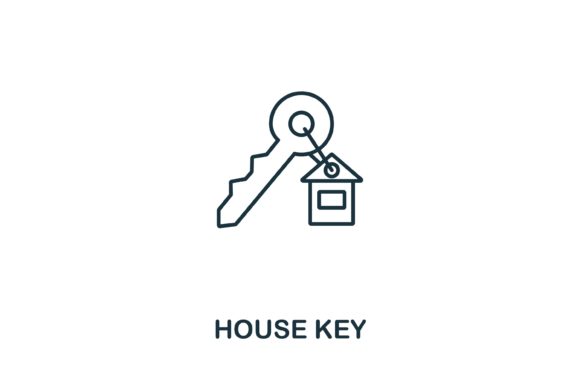
In the visual language of real estate and property management, few symbols carry as much immediate recognition and emotional weight as the house key. For designers, marketers, and business owners, securing a high-quality House Key icon is often the first step in establishing trust and clarity in digital and print communications. This specific line style symbol serves as more than just a decorative element; it functions as a critical navigational cue and a metaphor for access, security, and new beginnings. When sourced from a professional real estate icon collection, this vector graphic provides the technical flexibility needed for modern UX/UI projects while maintaining the aesthetic warmth required for branding.
The Strategic Value of Line Style Symbols
Choosing a line style representation over a solid or filled glyph offers distinct advantages in contemporary interface design. The House Key icon in a linear format reduces visual noise, allowing it to sit comfortably alongside text, photography, and other UI elements without competing for attention. This minimalism is particularly valuable in mobile-first designs where screen real estate is limited. A clean line art symbol scales down effectively for app navigation bars or tab menus while retaining its legibility. Conversely, when enlarged for a hero section on a landing page or a large-format infographic, the vector lines remain crisp and professional.
Beyond aesthetics, the line style conveys a sense of modernity and transparency. In an industry often associated with complex paperwork and opaque processes, a simple, open outline suggests straightforwardness and ease. This subtle psychological cue can enhance user experience by making property listings, mortgage calculators, or client portals feel more approachable. For creators building infographics about home buying steps or rental agreements, this icon acts as an effective visual anchor, breaking up dense text and guiding the reader’s eye through sequential information logically.
Technical Flexibility: EPS and JPG Formats
The practical utility of any design asset lies in its file formats, and this package delivers both EPS and JPG options to cover diverse workflows. Understanding when to use each format is essential for maximizing efficiency and output quality.
- EPS (Encapsulated PostScript): This is your primary source file for editing and scaling. As a vector format, the EPS version of the House Key icon allows you to resize the graphic infinitely without pixelation. It is the necessary choice for logo creation, large banners, vehicle wraps, and high-resolution print materials. Crucially, it enables color customization; you can adjust the stroke width, change the line color to match brand guidelines, or modify the shape slightly to create a unique derivative work.
- JPG (Joint Photographic Experts Group): While vectors are superior for design, rasterized JPGs offer immediate convenience for non-design contexts. This format is ideal for quick mockups, email signatures, social media posts, or internal presentations where opening vector software is unnecessary. Having a pre-rendered JPG saves time when you need to insert the symbol into a Word document, PowerPoint slide, or basic web content without worrying about compatibility or rendering issues.
This dual-format approach supports both professional designers who require granular control and entrepreneurs or educators who need plug-and-play simplicity. It eliminates the friction of converting files or searching for alternative versions mid-project.
Applications in Branding and Identity
For small business owners and freelancers in the housing sector, the House Key icon frequently serves as a foundational creative element for logos. Its universal recognition means you do not need to spend marketing budget explaining what the symbol represents. However, successful branding requires thoughtful integration rather than generic placement. When using this vector graphic for a logo, consider how the negative space interacts with your typography. The line style allows for creative interlocking with letterforms or enclosure within geometric shapes, creating a proprietary mark that feels custom-designed even when starting from a stock collection.
Real estate agents and brokers can leverage this symbol to reinforce personal branding across touchpoints. Consistency builds familiarity; using the same key icon on business cards, website favicons, listing flyers, and closing gifts creates a cohesive visual identity. Because the EPS file is fully editable, you can create variations for different backgrounds—such as a white line version for dark mode interfaces or a monochrome version for embossed stationery—while maintaining brand integrity.
Enhancing User Experience and Interface Design
In UX/UI design, icons must function as intuitive signifiers. The House Key icon excels in specific interaction patterns common to property platforms. It is naturally suited for "Login" or "Member Access" buttons, leveraging the mental model of keys granting entry. It also works effectively for "Save to Favorites" or "My Listings" features, where the key metaphor implies ownership or personal curation. For rental platforms, it can distinguish verified properties or secure booking flows.
When implementing this symbol in interfaces, pay close attention to stroke consistency. If your design system uses 2px strokes with rounded caps, ensure the House Key icon matches these parameters. The editable nature of the EPS file makes this alignment possible, preventing the jarring visual disconnect that occurs when mixing disparate icon styles. This attention to detail signals professionalism and care, qualities that directly influence user trust in financial and housing transactions.
Considerations for Effective Implementation
While versatile, the House Key icon is not a universal solution for every real estate context. Designers should evaluate fit based on specific communication goals. A traditional key shape may imply physical locks and older housing stock, which might misalign with smart home technology brands or futuristic architectural firms. In such cases, comparing this option against digital lock or fingerprint icons ensures the visual metaphor matches the product reality.
Cultural context also matters. Key designs vary globally; ensure the silhouette resonates with your target audience's regional expectations. Additionally, consider accessibility. When using the icon in digital products, always pair it with appropriate alt text or visible labels. Relying solely on the symbol without textual support can exclude users with cognitive disabilities or those unfamiliar with the convention. The line style generally offers good contrast, but testing against WCAG standards remains necessary for inclusive design.
Streamlining Creative Workflows
Time is often the scarcest resource for marketers and solo creators. Sourcing a well-crafted, editable House Key icon from a dedicated collection eliminates hours of custom illustration or the frustration of tracing low-quality internet images. The "easy to edit and use" promise translates directly to project velocity. Instead of wrestling with poorly constructed paths or incompatible layers, you can focus on strategic design decisions and content messaging.
For educators and bloggers creating content about homeownership, tenancy rights, or real estate investing, having a reliable visual library accelerates production. Complex concepts like escrow, title transfer, or lease signing become digestible when paired with clear iconography. The ability to quickly recolor and resize the asset means you can maintain visual consistency across dozens of articles or slides without repetitive labor. This efficiency compounds over time, allowing for higher output volume and faster iteration cycles.
Ultimately, the value of this House Key icon lies in its balance of symbolic resonance and technical pragmatism. It bridges the gap between emotional storytelling and functional design requirements. Whether you are crafting a corporate identity, designing a seamless app experience, or illustrating an educational guide, this asset provides a solid foundation. By understanding its strengths in line style representation, leveraging the flexibility of EPS and JPG formats, and applying it with intentionality, you transform a simple graphic into a powerful tool for communication and connection in the real estate landscape.