Presentation Template - Happen: A Structural Analysis for Modern Visual Communication
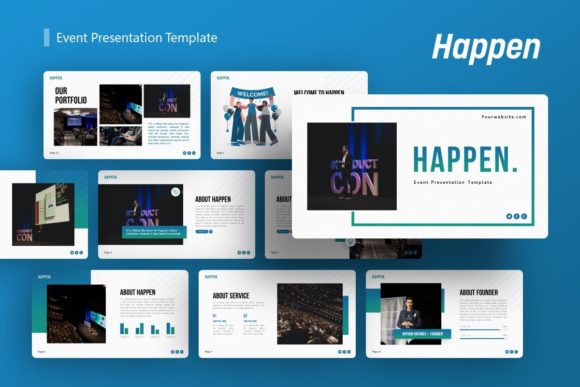
In the contemporary landscape of digital communication, the efficacy of a presentation is often determined not just by the spoken word, but by the visual architecture that supports it. The Presentation Template - Happen represents a specific category of design assets engineered to bridge the gap between raw data and compelling narrative. Unlike generic slide decks that serve merely as background texture, this template system functions as a comprehensive visual framework. It addresses the fundamental challenge faced by professionals across diverse sectors: how to maintain brand consistency and visual engagement without investing hundreds of hours in bespoke graphic design. By examining the structural components and practical applications of Introducing Happen Event Presentation Template, users can better understand how to leverage pre-designed systems to enhance clarity, retention, and professional credibility.
Architectural Flexibility Across Diverse Professional Verticals
The primary value proposition of the Presentation Template - Happen lies in its agnostic design philosophy. While many templates are niche-specific, this system is architected to support a wide spectrum of use cases through modular adaptability. This versatility is critical for organizations or individuals who manage multiple types of communications under a single workflow.
Corporate Identity and Business Reporting
For corporate entities and business units, the template serves as a standardized vessel for company profiles and quarterly reports. The inclusion of handcrafted infographics within PowerPoint allows complex datasets to be translated into digestible visual formats. In a business context, where stakeholder attention spans are limited, the ability to present financial projections or organizational structures through pixel-perfect illustrations ensures that the focus remains on strategic insights rather than deciphering cluttered spreadsheets. The master slide functionality ensures that logos, color palettes, and typography remain consistent across all 36 slides, reinforcing corporate identity without manual formatting checks.
Creative Agencies and Portfolio Management
Creative professionals face a unique paradox: their presentation materials must demonstrate design competence while showcasing client work. The Presentation Template - Happen addresses this by providing a neutral yet sophisticated backdrop suitable for photography and creative portfolios. The drag-and-drop picture placeholders allow photographers and designers to insert high-resolution imagery without breaking the layout grid. This is particularly relevant for pitch decks where the visual quality of the slide itself acts as a proxy for the agency’s attention to detail. The resizable graphic elements ensure that whether the portfolio is displayed on a large conference screen or a laptop, the aspect ratios and visual hierarchy remain intact.
Startup Ecosystems and Investor Relations
Startups operate in high-stakes environments where the pitch deck is often the first point of contact with potential investors. Introducing Happen Event Presentation Template provides the structural scaffolding necessary for these critical narratives. The 36-slide count offers sufficient depth to cover problem statements, market analysis, product demonstrations, and financial asks without forcing founders to build layouts from scratch. More importantly, the vector icon integration allows for the rapid visualization of abstract tech concepts or service models, which is essential when explaining innovative solutions to non-technical stakeholders.
Technical Specifications and Workflow Integration
Beyond aesthetic considerations, the utility of any presentation asset is defined by its technical interoperability and ease of manipulation. The Presentation Template - Happen is built specifically for the Microsoft PowerPoint ecosystem (.PPTX), ensuring compatibility with the most widely used presentation software in enterprise and education. Understanding the technical features is essential for maximizing efficiency during the creation process.
- Master Slide Architecture: The template utilizes a robust master slide system. This means that global changes—such as updating a brand color or repositioning a footer—can be applied to all relevant slides simultaneously. This feature drastically reduces the time required for revisions and ensures zero-deviation consistency.
- Vector-Based Scalability: All included graphics and icons are vector-based. Unlike raster images that pixelate when enlarged, these elements maintain crisp edges at any resolution. This is vital for modern hybrid presentations that may be viewed on everything from mobile devices to 4K projection systems.
- Editable Infographic Components: The handcrafted infographics are not static images; they are native PowerPoint shapes. Users can edit text, change colors, and adjust data representations directly within the software without needing external tools like Adobe Illustrator. This democratizes high-end data visualization for users without specialized design training.
- Intuitive Asset Replacement: The drag-and-drop picture placeholder system streamlines the content population phase. Users simply drag their media into the designated frame, and the template automatically crops and masks the image to fit the design intent. This eliminates the tedious process of manual cropping and alignment.
Strategic Implementation of Visual Assets
Acquiring the Presentation Template - Happen is only the first step; effective implementation requires a strategic approach to content placement and customization. The files included in the package—the .PPTX file, documentation, and vector icons—are resources that must be managed thoughtfully to avoid common pitfalls associated with template usage.
Navigating Content Density and Slide Count
With 36 unique slides available, there is a temptation to utilize excessive volume. However, best practices in presentation design suggest that more slides do not equate to better communication. Users should treat the 36 slides as a library of options rather than a mandatory checklist. Selecting only the layouts that directly support the narrative arc prevents audience fatigue. For example, a personal portfolio might only require ten carefully curated slides, whereas a comprehensive corporate audit might utilize twenty-five. The abundance of choice is a safety net, not a requirement.
Customization Beyond Surface-Level Edits
To truly make the Introducing Happen Event Presentation Template feel unique, users must move beyond simple text replacement. True customization involves adapting the visual tone to match the specific emotional resonance of the content. This might involve adjusting the opacity of background elements to improve text readability, modifying the spacing between infographic elements to create breathing room, or combining elements from different master slides to create hybrid layouts. The documentation file included with the download serves as a crucial guide for these deeper modifications, explaining the logic behind the layer structure and offering troubleshooting for common editing challenges.
Managing Media Expectations and Licensing
A critical operational note for all users is the distinction between the template structure and the preview content. As explicitly stated in the product specifications, all images shown in the demo are for preview purposes only and are not included in the downloadable files. This is a standard industry practice designed to protect photographer copyrights and keep file sizes manageable. Professionals must plan for the acquisition or creation of their own imagery before beginning the assembly process. Relying on stock photography that matches the template’s aesthetic is recommended to maintain the polished look demonstrated in the previews. Furthermore, understanding licensing terms for the vector icons and fonts ensures compliance when distributing the final presentation externally.
Evaluating Design Efficiency and Return on Investment
For decision-makers evaluating whether to adopt the Presentation Template - Happen, the assessment should extend beyond visual appeal to consider operational efficiency. In a professional setting, time is a tangible cost. Creating a high-quality, custom-designed presentation from a blank canvas typically requires 20 to 40 hours of skilled labor. By utilizing a pre-engineered system with pixel-perfect illustrations and established grids, this timeline can be reduced to a fraction of the original estimate.
This efficiency gain allows teams to redirect resources toward content strategy, rehearsal, and data verification—activities that have a higher correlation with presentation success than graphic design alone. Additionally, the reusable nature of the master slides creates a long-term asset. Once an organization adapts the template to its brand guidelines, it becomes a proprietary tool for future communications, compounding the return on investment over time.
The educational sector also benefits from this efficiency model. Researchers and educators often need to translate dense academic findings into accessible lectures. The structured layouts of Happen provide a cognitive framework that helps organize information logically. When students or conference attendees can anticipate the flow of information based on consistent visual cues, cognitive load decreases, and information retention improves. The template thus acts as a pedagogical aid, not just a decorative overlay.
Maintaining Authenticity in Templated Communications
A common concern among creatives and thought leaders is that using a template like Presentation Template - Happen might result in a generic or derivative appearance. Avoiding this requires intentional curation. The template provides the grammar of visual language, but the user must supply the vocabulary. Authenticity is achieved when the selected slides perfectly mirror the unique structure of the argument being made, rather than forcing the argument to fit arbitrary slide designs.
Furthermore, the integration of personal or proprietary data into the editable infographics instantly differentiates the output from the stock demo. When a startup inserts its actual user growth metrics into the provided chart layouts, or when a photographer places their exclusive captures into the gallery grids, the template recedes and the content takes precedence. The goal of Introducing Happen Event Presentation Template is to become invisible infrastructure that elevates the message. By focusing on the intersection of technical capability and narrative necessity, users can harness this tool to produce work that is both professionally polished and distinctly their own.