Google Slides Template - Jobcent: A Strategic Framework for Modern Business Presentations
In the contemporary digital landscape, the ability to communicate complex ideas visually is as critical as the content itself. For professionals ranging from startup founders to creative directors, the search for a versatile presentation asset often leads to specialized tools designed to bridge the gap between data and narrative. The Google Slides Template - Jobcent represents a significant evolution in this space, offering a comprehensive suite of visual assets that cater to diverse professional needs. While primarily marketed under the "Jobcent" branding for recruitment and corporate profiling, its underlying architecture supports a much broader spectrum of applications, including pitch decks, personal portfolios, and educational lectures. Understanding how to leverage such a template requires looking beyond the aesthetic surface to examine the structural benefits, customization workflows, and strategic implementation across different industries.
Versatility Across Professional Verticals
The primary strength of introducing Jobcent business presentation assets into a workflow lies in their adaptability. Unlike niche templates restricted to a single industry, this framework is engineered for cross-functional use. This versatility is not accidental but rather a result of modular design principles that allow users to repurpose slides without breaking visual consistency.
Corporate Identity and Company Profiles
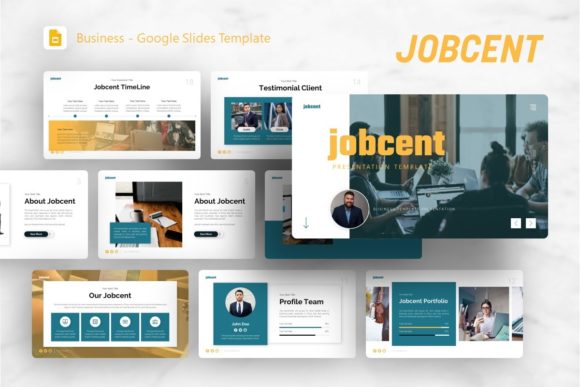
For established businesses, maintaining brand coherence across internal and external communications is paramount. The Jobcent template provides a structured environment for company profiles where typography, color palettes, and layout grids are pre-aligned. This ensures that when a marketing team creates a quarterly review or an HR department presents onboarding materials, the visual language remains consistent. The inclusion of 36 distinct slides allows organizations to build a master library of approved layouts, reducing the time spent on formatting and increasing the focus on message clarity. Corporate users benefit specifically from the handcrafted infographics included in the package, which transform dry annual reports or organizational charts into engaging visual stories.
Creative Agencies and Portfolios
Creative professionals face a unique challenge: their presentation must demonstrate design competence while showcasing client work. The Google Slides Template - Jobcent addresses this through pixel-perfect illustrations and resizable graphic elements. For photographers and designers, the picture placeholder functionality acts as a non-destructive framing tool. Users can drag and drop high-resolution assets without worrying about aspect ratio distortion or alignment issues. This feature is particularly valuable for personal portfolios where the layout must adapt to varying image dimensions while maintaining a polished, gallery-like appearance. The clean, minimalist aesthetic inherent in the Jobcent design prevents the template from competing with the portfolio pieces themselves, ensuring the creator’s work remains the focal point.
Startups and Pitch Decks
In the high-stakes environment of venture capital fundraising, clarity equals credibility. Startups utilizing this template gain access to pre-structured narrative flows essential for pitch decks. The 36-slide count is significant here; it provides enough variety to cover problem statements, market analysis, business models, and financial projections without forcing presenters to create custom layouts from scratch. The vector icons and editable graphics allow founders to visualize abstract concepts like "scalability" or "user acquisition funnels" quickly. Because the template is based on master slides, global changes to font sizes or color schemes can be applied instantly across the entire deck, allowing for rapid iteration based on investor feedback or specific audience tailoring.
Technical Architecture and Customization Workflow
Beyond its visual appeal, the utility of any presentation asset is defined by its technical foundation. The Jobcent template distinguishes itself through specific engineering choices that streamline the editing process for users of varying technical proficiency.
Master Slide Integration
A common pain point with lower-quality templates is the lack of proper master slide hierarchy, forcing users to format individual slides manually. The Jobcent system is built entirely on master slides, which serves as the central control panel for the presentation. This architecture means that a change made to a logo placement or footer text in the master view propagates automatically to every relevant slide. For teams collaborating on a single deck, this reduces version control errors and ensures that branding guidelines are enforced structurally rather than relying on individual vigilance. It also significantly accelerates the creation of new slides, as users can simply select a pre-formatted layout from the master menu rather than adjusting text boxes and shapes individually.
Vector Graphics and Resizability
Resolution independence is a critical factor for presentations that may be viewed on devices ranging from mobile phones to large conference hall projectors. All graphics within the Jobcent ecosystem are fully resizable and editable vectors. Unlike raster images that pixelate when enlarged, these elements maintain crisp edges at any scale. More importantly, because they are editable, users can modify colors, stroke weights, and even node structures directly within PowerPoint or Google Slides. This eliminates the need for external vector editing software like Adobe Illustrator for minor adjustments. If a chart needs to match a specific brand hex code, it can be recolored natively within the presentation environment, preserving the integrity of the file structure.
Drag-and-Drop Media Handling
The efficiency of populating a template often dictates its adoption rate. The picture placeholder system in Jobcent is designed for intuitive interaction. Rather than cropping images externally and pasting them in, users utilize native masking tools. This non-destructive workflow allows for real-time repositioning of images within their frames. For educators or researchers handling large volumes of visual data, this feature drastically reduces preparation time. It also encourages experimentation with layout, as swapping visuals becomes a low-friction task, enabling presenters to test different visual metaphors without rebuilding slides.
Strategic Considerations for Implementation
While the Google Slides Template - Jobcent offers robust features, maximizing its value requires strategic consideration of file management, licensing, and content adaptation. Professionals should approach the template not as a finished product but as a foundational system to be customized.
File Format Compatibility and Documentation
The package includes a PowerPoint .PPTX file, which serves as the universal source format. Even for users intending to present via Google Slides, starting with the native PPTX ensures that all master slide relationships and vector properties are preserved during upload. Conversion directly within cloud platforms can sometimes degrade complex formatting. The included documentation file is an essential resource that outlines specific font dependencies and icon usage rights. Ignoring this documentation is a frequent cause of rendering issues; ensuring that recommended typefaces are installed or substituted correctly before beginning edits prevents layout shifts later in the process. The vector icon set included adds further value, providing a cohesive library of symbols that match the template’s line weight and style, preventing the visual dissonance that occurs when mixing disparate icon packs.
Navigating Preview vs. Actual Assets
A crucial distinction for users to understand is the separation of demo content from functional assets. As noted in the product specifications, all images in the preview are for demonstration purposes only and are not included in the downloadable files. This is standard practice in digital asset distribution due to licensing restrictions. Users must be prepared to source their own photography or utilize royalty-free stock libraries. However, this limitation also serves as a creative safeguard; it prevents the "template look" where multiple companies inadvertently use identical stock photos. By requiring users to insert their own imagery, the template forces a level of customization that ultimately results in a more authentic and unique final presentation. Smart users will curate their image assets before opening the template to ensure a streamlined assembly process.
Adapting Infographics for Data Integrity
The handcrafted infographics provided are aesthetically pleasing but require careful adaptation to ensure they accurately represent user data. There is a temptation to force data to fit a beautiful chart rather than selecting the right visualization for the dataset. When using the Jobcent infographic suite, professionals should prioritize accuracy over decoration. Because the elements are editable, users can delete unnecessary components or simplify complex diagrams to better suit their specific metrics. For researchers and analysts, this means treating the infographic slides as starting points for data storytelling rather than rigid containers. The ability to edit these graphics ensures that the visual representation remains truthful to the underlying information, adhering to best practices in data visualization ethics.
Enhancing Communication Through Design Systems
Ultimately, the adoption of a comprehensive tool like the Google Slides Template - Jobcent reflects a shift toward systematic design thinking in business communication. It moves professionals away from ad-hoc slide creation toward a standardized visual vocabulary. Whether used for a creative agency portfolio, a startup pitch, or a corporate training session, the template provides a reliable infrastructure that supports clear messaging. By leveraging features like master slides, vector editability, and modular layouts, users can reduce production friction and elevate the perceived professionalism of their output. In an era where attention spans are short and visual standards are high, having a robust, flexible presentation framework is not merely a convenience—it is a competitive advantage that enables clearer, more impactful communication across every sector of the modern economy.