Google Slides Template - Duty: A Strategic Framework for Professional Communication
Selecting the right presentation asset is rarely just about aesthetics; it is a fundamental business decision that influences how stakeholders perceive your competence, clarity, and strategic direction. The Google Slides Template - Duty serves as more than a visual container for text and images. It functions as a structured communication framework designed to bridge the gap between complex ideas and audience understanding. For professionals ranging from startup founders to corporate executives, this template offers a pre-validated architecture that reduces cognitive load during the creation process while elevating the perceived value of the final deliverable. Understanding its strategic utility requires looking beyond the slide count and examining how its design principles support specific business outcomes.
Aligning Visual Structure with Business Objectives
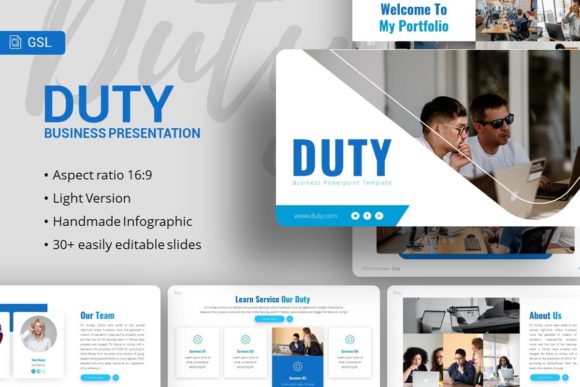
The primary strategic advantage of adopting the Google Slides Template - Duty lies in its versatility across distinct professional contexts. Whether utilized for a Creative Agency pitch, a Company Profile, or a Personal Portfolio, the underlying grid system enforces a level of discipline that ad-hoc design often lacks. This discipline is critical for decision-makers who must communicate value propositions quickly. The template’s 35 unique slides are not merely variations of layout; they represent different rhetorical modes. Some slides are optimized for data visualization through handcrafted infographics, while others prioritize narrative flow or emotional connection through photography-focused placeholders.
When planning a presentation, users should map their content hierarchy to these specific slide types before inserting a single word. For example, a Startup preparing for a seed round might leverage the template’s pitch deck layouts to structure their problem-solution narrative, ensuring investors receive information in a familiar, digestible cadence. Conversely, a Corporate team presenting quarterly results can utilize the infographic-heavy slides to transform dense spreadsheets into accessible insights. This intentional alignment prevents the common pitfall of forcing content into inappropriate formats, thereby preserving the integrity of the message and respecting the audience's time.
Operational Efficiency Through Master Slide Architecture
Time is a finite resource for entrepreneurs, marketers, and educators. The operational value of this template stems from its foundation on Master Slides. Unlike basic templates where changes must be made manually on every page, the Duty template allows for global, consistent updates across the entire deck. This feature is particularly relevant for organizations maintaining brand consistency across multiple departments or client projects. By defining color palettes, typography, and logo placement at the master level, teams ensure that every output adheres to brand guidelines without requiring constant oversight from a design lead.
This efficiency extends to the editing workflow. All graphics within the Google Slides Template - Duty are fully resizable and editable vector elements, not static images. This distinction is vital for long-term usability. As business metrics change or services evolve, users can modify charts and icons directly within the platform without returning to external design software. The inclusion of drag-and-drop picture placeholders further streamlines the production cycle, allowing non-designers to achieve pixel-perfect results. However, practitioners should approach this ease of use with caution. Speed should never supersede relevance. The ability to populate 35 slides quickly does not imply that all 35 should be used. Strategic restraint is often more impressive than volume.
Mitigating Risks in Template-Based Communication
While the Google Slides Template - Duty provides a robust starting point, relying on it without clear goals introduces significant risks. The most prevalent danger is the "generic trap," where presentations begin to look identical because users rely solely on default arrangements. To avoid this, treat the template as a skeleton rather than a finished body. Customization must go beyond swapping logos; it involves adapting the tone, density, and flow of information to match the specific psychological needs of your audience. A portfolio for a photographer requires a vastly different pacing and whitespace ratio than a B2B service proposal, even if both use the same underlying file.
Another risk involves licensing and asset management. Users must understand that demo images are for preview purposes only and are not included in the downloadable files. Failing to account for this can lead to last-minute scrambles for high-quality imagery or, worse, copyright infringement. Strategic planning includes auditing your existing media assets against the template’s requirements before beginning the build. Additionally, while the template includes vector icons, over-reliance on iconography can sometimes trivialize serious topics. Evaluate whether an abstract icon truly conveys the necessary weight of a concept, or if a concrete photograph or detailed diagram would serve the communication goal more effectively.
Enhancing Stakeholder Engagement and Retention
Effective communication is measured by retention and action, not just delivery. The handcrafted infographics included in the Google Slides Template - Duty are designed to leverage dual-coding theory, which suggests that combining verbal and visual information enhances memory. When presenting complex operational data or market analysis, these pre-designed visual aids help anchor abstract concepts in the viewer's mind. However, the effectiveness of these tools depends entirely on the quality of the input data and the presenter's ability to narrate them.
For educators and trainers, this template offers a way to standardize learning materials while keeping them visually engaging. Consistency in slide design reduces extraneous cognitive load, allowing students to focus on learning objectives rather than deciphering new layouts for every lesson. Similarly, freelancers and consultants can use the template to create reusable case study frameworks. By establishing a standard format for presenting past work, you reduce the friction of creating new proposals and allow potential clients to compare your capabilities apples-to-apples. This systematic approach to self-presentation signals professionalism and organizational maturity, traits that high-value clients actively seek.
Technical Considerations and File Management
Practical execution requires attention to technical details. The package includes a PowerPoint .PPTX file alongside the Google Slides version, providing flexibility for users operating in mixed-software environments. While Google Slides offers superior collaboration features, some corporate firewalls or legacy systems may still prefer PPTX. Maintaining access to both formats ensures interoperability with diverse stakeholder ecosystems. The included documentation file is another underutilized asset. Experienced users know that reading the creator’s notes can reveal hidden features or intended workflows that aren't immediately obvious upon opening the file. Skipping this step often leads to reinventing the wheel or misusing complex master slide components.
Furthermore, consider the long-term maintenance of your presentation assets. Because all graphic elements are editable, the Google Slides Template - Duty can evolve with your organization. Create a "source of truth" master copy that contains your updated branding, approved imagery, and standardized data tables. Distribute only working copies to team members. This version control strategy prevents brand drift and ensures that the efficiency gains promised by the template are realized consistently over months and years, rather than just in the initial deployment.
Making the Decision to Adopt
Ultimately, the decision to implement the Google Slides Template - Duty should be driven by a gap analysis of your current communication capabilities. If your team struggles with inconsistency, spends excessive hours on formatting, or fails to convert audiences due to poor visual hierarchy, this tool addresses those specific pain points. However, if your primary challenge is messaging strategy or market fit, a template will not solve the underlying problem. It amplifies what already exists.
Approach this asset as a productivity multiplier and a quality baseline. Use it to handle the heavy lifting of visual structure so that your intellectual energy remains focused on insight generation, relationship building, and strategic storytelling. When used intentionally, with respect for both the audience's needs and the medium's constraints, this template transforms from a simple digital download into a reliable component of your broader business infrastructure. The goal is not to have the prettiest slides, but to facilitate the clearest possible transfer of meaning from your mind to your stakeholder's understanding. That is the true duty of any professional presentation tool.