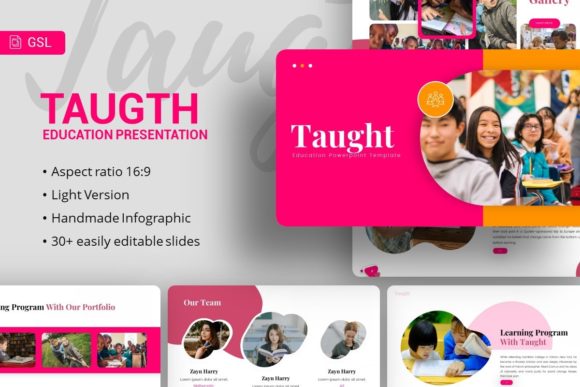
Google Slides Template - Taught: A Comprehensive Framework for Professional and Educational Presentations
In the digital communication landscape, the efficacy of a presentation often hinges as much on its visual architecture as it does on the spoken narrative. For professionals, educators, and creatives seeking a versatile foundation for their slide decks, the Google Slides Template - Taught offers a structured yet flexible solution. This resource is designed to bridge the gap between rigid corporate formatting and the dynamic needs of modern storytelling. By integrating thirty-five distinct slides with handcrafted infographics and master slide functionality, this template serves as a robust toolkit for diverse applications ranging from startup pitch decks to academic lectures and personal portfolios.
Versatility Across Professional and Creative Domains
The primary strength of the Google Slides Template - Taught lies in its adaptability. Unlike niche-specific themes that lock users into a singular aesthetic or structural flow, this template is engineered for cross-industry utility. Understanding how to leverage this versatility requires examining its specific use cases in real-world scenarios.
Corporate Identity and Business Reporting
For established companies and emerging businesses alike, maintaining brand consistency across internal and external communications is paramount. The template’s company profile and corporate business layouts provide pre-structured environments for annual reports, quarterly reviews, and strategic planning sessions. Because the design relies on master slides, organizations can implement global changes to color palettes, typography, and logo placement instantly. This ensures that a marketing team creating a campaign overview and a finance team presenting budget forecasts are utilizing a cohesive visual language without redundant formatting efforts.
Creative Agency and Portfolio Showcases
Creative professionals face the unique challenge of presenting work within a presentation format without letting the template overshadow the content. The Google Slides Template - Taught addresses this through clean, minimalist layouts specifically optimized for photography and portfolio displays. The picture placeholders utilize drag-and-drop functionality, allowing photographers and designers to swap assets rapidly while maintaining aspect ratios and alignment. This feature is particularly valuable for creative agencies pitching to clients, where the ability to customize a portfolio deck on the fly can demonstrate responsiveness and attention to detail.
Educational Instruction and Academic Research
True to its name, the template excels in educational settings. Researchers, teachers, and trainers can utilize the infographic-heavy slides to break down complex data sets, historical timelines, or scientific processes into digestible visual components. The inclusion of vector icons and resizable graphics allows educators to create custom diagrams directly within the slide environment, reducing the need for external graphic design software. This capability supports pedagogical best practices by facilitating dual coding—combining verbal explanations with relevant visual representations to enhance learner retention.
Startup Pitch Decks and Investor Relations
Startups require a narrative structure that balances vision with tangible data. The template includes specific slide variations tailored for pitch decks, such as problem-solution frameworks, market size visualizations, and team introduction grids. These layouts are designed to guide the presenter through a logical flow that investors expect, while the pixel-perfect illustrations add a layer of polish that signals professionalism. For entrepreneurs, using a structured template like Taught reduces the cognitive load associated with design, allowing more focus on refining the business model and value proposition.
Technical Architecture and Customization Capabilities
Beyond aesthetic appeal, the functional value of a presentation template is determined by its technical construction. The Google Slides Template - Taught is built with user autonomy in mind, prioritizing editability over static design. Several key technical features distinguish this resource from basic free themes.
Master Slide Integration
The backbone of efficient slide design is the Master Slide system. This template utilizes a comprehensive master slide setup that controls global elements across all thirty-five unique layouts. When a user modifies a font style, adjusts a color scheme, or repositions a footer element on the master slide, those changes propagate automatically to every associated slide. This hierarchical editing capability is essential for large-scale projects where manual adjustments would be prohibitively time-consuming. It also safeguards against formatting inconsistencies that often arise when multiple team members collaborate on a single deck.
Handcrafted Infographics and Vector Assets
Data visualization is often the most labor-intensive aspect of presentation creation. This template alleviates that burden by providing handcrafted infographics that are fully editable within PowerPoint and Google Slides. Unlike raster images that lose quality when resized, these graphics are vector-based, ensuring crisp rendering at any dimension. Users can modify chart values, adjust segment colors, and resize individual elements without breaking the overall composition. The inclusion of a dedicated vector icon set further enhances this flexibility, allowing presenters to build custom visual metaphors that align precisely with their specific content rather than relying on generic stock imagery.
Cross-Platform File Compatibility
Although marketed as a Google Slides resource, the template acknowledges the reality of mixed-software environments. The package includes a native PowerPoint .PPTX file alongside documentation, ensuring compatibility for users who may need to transition between platforms. This dual-format approach is critical for collaborative teams where stakeholders may have different software preferences. The pixel-perfect illustrations and graphic elements are tested to maintain integrity during conversion, preventing the layout shifts and font substitutions that frequently plague cross-platform workflows.
Strategic Implementation and Workflow Optimization
Acquiring a high-quality template is only the first step; maximizing its potential requires a strategic approach to implementation. Users should consider several workflow optimizations when adopting the Google Slides Template - Taught.
Establishing a Visual System Before Content Creation
Rather than inserting content immediately, effective users first configure the master slides to match their brand guidelines or project requirements. By defining the color hierarchy, selecting appropriate typefaces, and setting up recurring visual motifs upfront, creators establish a visual system that streamlines subsequent slide production. This preparatory phase prevents mid-project redesigns and ensures that the final output feels intentional rather than assembled.
Leveraging Placeholder Logic
The drag-and-drop picture placeholders are designed to enforce visual consistency. Users should resist the urge to manually position images outside these designated areas unless absolutely necessary. Adhering to the placeholder grid maintains the rhythmic spacing and alignment that professional designers embed into templates. When custom imagery is required, utilizing the built-in cropping and masking tools within the platform preserves the template’s intended aesthetic balance.
Content-First Adaptation
With thirty-five slides available, there is a risk of including unnecessary content simply because a layout exists. Best practice dictates selecting only the slides that serve the narrative arc. The template’s modular nature allows users to delete unused slides without affecting the master slide relationships. This selective approach keeps presentations concise and audience-focused. Additionally, because all graphics are resizable and editable, users should feel empowered to deconstruct complex infographics into simpler elements if their specific data set does not require the full complexity of the original design.
Considerations for Asset Management and Licensing
When integrating third-party templates into professional or educational workflows, understanding asset management and licensing boundaries is crucial for avoiding legal or technical pitfalls.
Preview vs. Included Assets
A common point of confusion with digital templates involves demo imagery. It is important to note that all images shown in the preview of the Google Slides Template - Taught are for demonstration purposes only and are not included in the downloadable files. Users must supply their own photography and visual assets. This distinction actually benefits the end-user by ensuring that the final presentation features original, rights-cleared content rather than ubiquitous stock photos that may appear in competitors’ materials. Teams should prepare their image libraries before beginning the design process to maintain momentum.
Documentation as a Learning Resource
The included documentation file serves as more than just an installation guide; it functions as a reference manual for the template’s advanced features. Users unfamiliar with master slide editing or vector manipulation should consult this resource to unlock the full potential of the toolkit. Understanding the underlying structure prevents accidental corruption of layouts and accelerates the learning curve for team members who may be less experienced with presentation software.
Long-Term Maintainability
Because this template is based on standard PowerPoint and Google Slides architectures rather than proprietary plugins or scripts, it offers excellent long-term maintainability. Files created with Taught remain editable years later, even as software versions update. This future-proofing is particularly valuable for organizations that maintain archives of past presentations or need to update legacy decks with new data. The reliance on native platform features ensures that the investment in this template yields returns across multiple projects and fiscal cycles.
Enhancing Communication Through Design Structure
Ultimately, the value of the Google Slides Template - Taught extends beyond mere aesthetics. It provides a cognitive scaffold for both the presenter and the audience. Well-designed slides reduce extraneous cognitive load, allowing viewers to process information more efficiently. The template’s emphasis on clear hierarchy, consistent alignment, and meaningful data visualization aligns with evidence-based design principles that improve comprehension and recall.
For educators, this means students spend less mental energy deciphering cluttered slides and more energy engaging with the lesson material. For business professionals, it translates to clearer stakeholder communication and more persuasive proposals. For creatives, it provides a professional stage that elevates rather than distracts from their work. By treating this template as a communication framework rather than just a decorative skin, users can transform their presentation workflow from a source of stress into a strategic advantage. The combination of thirty-five versatile layouts, deep customization options, and cross-platform compatibility makes it a significant asset for anyone tasked with translating ideas into visual narratives.