Google Slides Template - GoGrowth: Streamlining Professional Presentation Workflows
In the modern professional landscape, the speed at which you can communicate complex ideas is often just as important as the ideas themselves. Whether you are preparing a quarterly financial report, pitching a new startup concept, or showcasing a creative portfolio, the visual structure of your presentation dictates how your audience receives your message. The Google Slides Template - GoGrowth serves as a foundational asset in this communication process, bridging the gap between raw data and compelling narrative. Rather than viewing a template as merely a decorative skin, productive teams and individuals should approach it as a workflow accelerator that standardizes quality while reducing the friction associated with slide design.
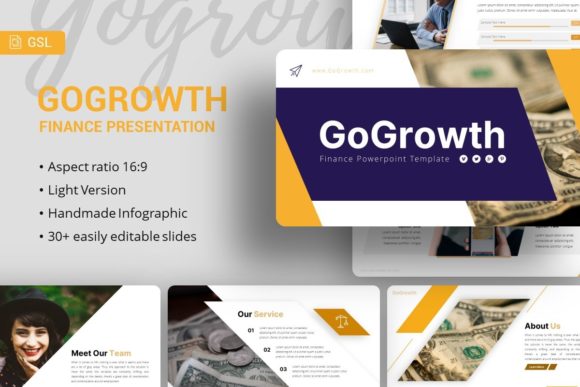
GoGrowth is designed to function within broader business and creative ecosystems. It fits into the workflow not as an isolated task, but as a central hub where strategy, branding, and content converge. By utilizing a pre-structured framework with 35 distinct slides, users can bypass the initial paralysis of the blank canvas. This allows for immediate focus on content curation and strategic messaging. The template’s architecture supports various stages of project development, from early-stage brainstorming and internal reviews to final client pitches and public-facing portfolios. Understanding where this tool fits into your specific operational rhythm is key to maximizing its utility beyond simple aesthetics.
Strategic Application Across Project Phases
The versatility of the Google Slides Template - GoGrowth becomes apparent when applied to different phases of a project lifecycle. Before a project fully launches, the template acts as a planning scaffold. Entrepreneurs and product managers can utilize the pitch deck layouts to stress-test their value propositions. If the content does not fit logically into the provided structures, it often indicates a gap in the business strategy itself. In this pre-launch phase, the template forces clarity and conciseness, ensuring that only the most critical information makes it to the screen.
During active project execution, particularly in corporate or agency environments, consistency is paramount. Team members often work asynchronously, contributing slides from different locations. GoGrowth’s reliance on Master Slides ensures that regardless of who adds content, the typography, color palette, and alignment remain uniform. This reduces the time spent on quality control and formatting corrections during the review process. For creative agencies and photographers, the portfolio layouts provide a grid system that maintains visual balance even as images are swapped out for different client presentations. The template adapts to the workflow rather than forcing the workflow to adapt to rigid design constraints.
Post-project, the template serves as an archival and reporting tool. The inclusion of handcrafted infographics allows teams to transform dense performance data into digestible visual summaries for stakeholders. Because the graphics are vector-based and editable within PowerPoint, these reports can be updated quarterly without requiring a graphic designer to recreate charts from scratch. This long-term usability transforms the template from a one-time purchase into a recurring asset for organizational knowledge management.
Integration with Broader Toolsets and Assets
No presentation exists in a vacuum. The Google Slides Template - GoGrowth is engineered to interact seamlessly with other digital resources and platforms. A critical feature for workflow efficiency is the drag-and-drop picture placeholder system. This functionality integrates directly with cloud storage solutions like Google Drive, Dropbox, or local asset libraries. Instead of manually cropping and resizing images to fit arbitrary shapes, users can pull assets directly into designated frames. This interoperability significantly speeds up the assembly process for photography portfolios and case studies where visual evidence is the primary driver of engagement.
Furthermore, the template includes a comprehensive set of vector icons. In many workflows, sourcing consistent iconography is a bottleneck that leads to mismatched visual styles. By having a unified icon library embedded within the file, users maintain semantic visual consistency across all 35 slides. These vectors are resizable without loss of quality, making them compatible with both high-resolution displays and printed handouts. When combined with external data visualization tools or spreadsheet software, the editable infographic slides act as the final rendering layer. You can analyze data in Excel or Sheets, determine the key takeaway, and then select the appropriate pre-built chart style in GoGrowth to visualize that insight professionally.
Collaboration is another integration point. Since the core file format is .PPTX, it maintains compatibility with Microsoft PowerPoint while being fully functional in Google Slides. This cross-platform flexibility is essential for teams with mixed software preferences. A marketer might build the deck in PowerPoint using advanced animation features, while a remote collaborator adds real-time comments and text edits via Google Slides. The documentation file included with the template serves as a shared reference point, ensuring all collaborators understand how to manipulate the master slides and placeholders correctly, thereby preventing accidental layout breakage during collaborative sessions.
Practical Implementation and Customization Workflow
To extract maximum value from the Google Slides Template - GoGrowth, users should adopt a systematic approach to customization. The first step in any implementation should always be reviewing the documentation file. While the interface is intuitive, understanding the hierarchy of the Master Slides prevents common errors. Many users attempt to edit elements on individual slides that are actually locked in the master view. Taking ten minutes to understand the template’s architecture saves hours of frustration later. Establish a "master copy" that remains untouched, and always duplicate this file for new projects to preserve the integrity of the original design system.
When customizing content, prioritize the pixel-perfect illustrations and resizable graphics. These elements are designed to scale proportionally. When adjusting the size of an infographic, hold the shift key (or use the aspect ratio lock in Google Slides) to prevent distortion. For personal portfolios and creative profiles, resist the urge to fill every slide. The template provides 35 options, but a strong presentation often uses fewer, more impactful slides. Curate the selection based on your narrative arc. Use the creative agency layouts for storytelling and the corporate layouts for data validation. Mixing these contexts intentionally can create a dynamic rhythm that keeps audiences engaged.
Efficiency also comes from leveraging the template’s modularity. Treat each slide as a standalone component that can be rearranged. If you are building a pitch deck, you might move the team introduction before the market analysis depending on your specific audience. The master slide system ensures that headers, footers, and page numbers update automatically during this reorganization. This modularity allows for rapid A/B testing of presentation flows. You can create two versions of a deck with different narrative structures in minutes, allowing you to tailor your approach for different stakeholders without rebuilding the visual foundation.
Quality Control and Long-Term Maintenance
Maintaining professional standards over time requires attention to detail regarding licensing and asset management. It is vital to remember that all images in the demo preview are for demonstration purposes only and are not included in the downloadable files. This distinction is crucial for avoiding copyright issues. Build a workflow that incorporates licensed stock photography or original assets immediately upon starting a new project. Create a dedicated folder for approved imagery that matches the GoGrowth aesthetic to ensure that user-uploaded content does not clash with the template’s sophisticated design language.
For organizations using this template repeatedly, consider creating a branded fork. Update the master slides with your company logo, specific brand colors, and preferred fonts once. Save this as your internal corporate template. This ensures that every employee, from interns to executives, produces output that aligns with brand guidelines without needing constant design oversight. The easy customizable contents of GoGrowth make this rebranding process straightforward. By investing time upfront to tailor the master slides, you reduce the cognitive load for future users and enforce visual consistency across the entire organization.
Finally, evaluate the template’s performance against your specific outcomes. If you find yourself consistently deleting certain slide types or struggling to fit your content into specific layouts, note these friction points. The goal is to streamline communication, not to force content into ill-fitting containers. Over time, refine your usage of the Google Slides Template - GoGrowth by keeping only the slides that serve your recurring needs and archiving those that do not. This iterative approach to template management ensures that the tool evolves alongside your business processes, remaining a relevant and effective asset for years to come. By treating the template as a living system rather than a static product, professionals can sustain high-quality output while adapting to changing communication demands.